aiga design educators conference
Every educator knows the moment. A student gets a mediocre grade, shrugs, and moves on. No reflection. No revision. Just a number filed away and a lesson left unlearned.
My colleague Andrea White and I have been sitting with that problem for years. In the summer of 2025, we had the opportunity to present our response to it at the AIGA Design Educators Community (DEC) WEAVE conference, and the conversation that followed reminded us exactly why this work matters.
Our session, "The Phased Module Framework: Designing for Iteration, Accountability, and Mastery," was built around a question we hear (and ask ourselves) constantly: How do we motivate students in problem-based learning environments while supporting their autonomy without burning ourselves out trying to grade everything?

Why We Built This
Design education sits at a complicated intersection. Success depends on more than technical skill: scaffolding, motivation, and identity all play a role. We kept running into the same friction points in our classrooms:
- Students who got a low grade and simply... moved on. No motivation to reflect or revise.
- Pre-exposure students surging early, then plateauing; while post-exposure students flounder.
- Learners who genuinely couldn't self-assess against assignment criteria, leading to frustration.
- Perhaps most painfully: students whose self-worth became too tightly tied to their output. When shame overrides effort, learning stops.
We grounded our thinking in research we'd come to trust: the motivational-cognitive scaffolding work of Belland, Kim & Hannafin (2013), Pearson & Gallagher's Gradual Release of Responsibility model (1983), and Vygotsky's Zone of Proximal Development (1978). These aren't new ideas, but applying them together, deliberately, in a studio context? That's where things got interesting.
The Framework, Simply Put
The Phased Module Framework structures coursework into modules, each containing sequential phases tied to specific learning outcomes. The key insight is this: process is valued as much as product.
Assessment is split: 90% on phases completed, 10% on process and feedback. Students can earn different outcomes based on how many phases they complete at a satisfactory level, which means the structure rewards persistence and iteration rather than a single high-stakes moment.
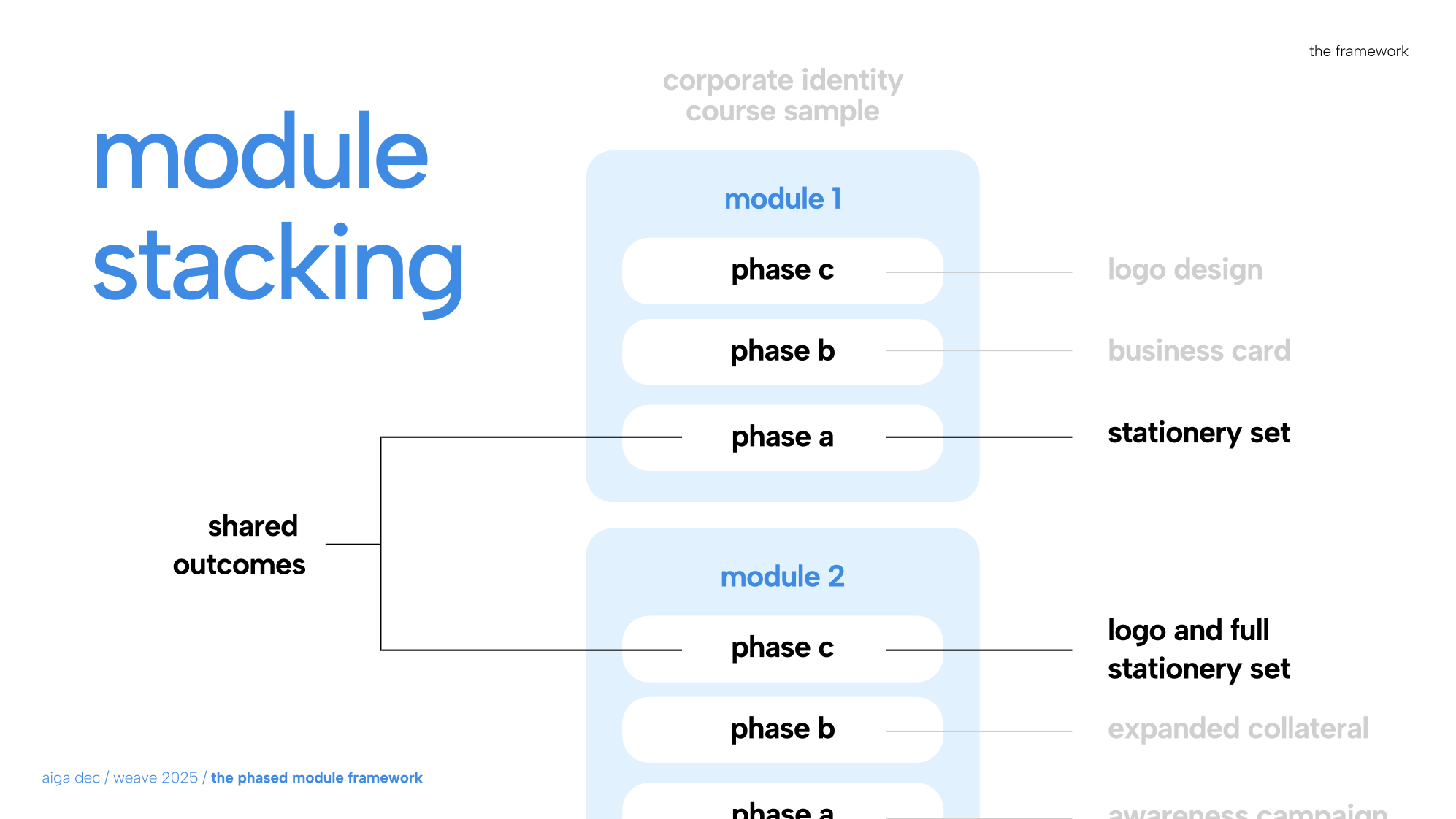
Modules can also stack across a course, sharing outcomes and building complexity. It's something we've used in a variety of studio courses, where early modules lay the groundwork for later, more demanding projects.
What it creates is a system where students have genuine control over their progress and the accountability to match.
If You Want to Try It
A few things we'd tell any educator considering this:
- Start with where it fits. Not every assignment or course needs this structure. Identify the spaces where iteration and autonomy are already valued then scaffold from there.
- Document your own practice. Reflective teaching artifacts aren't just good for scholarship; they're how you'll refine the framework over time for your own students.
- Define what you're assessing upfront. The framework works differently in lecture-based versus studio contexts. Clarity there saves a lot of confusion later.
If you'd like to explore the Phased Module Framework, whether you're curious about adapting it to your own course or want to dig into the research behind it, we'd love to continue the conversation. Reach out to either of us on LinkedIn or by email:
- Andrea White — andreaw@alextech.edu
- Cailey Birchem — cailey.birchem.2@alextech.edu
We built this because we believe students deserve learning structures that take their growth seriously and because educators deserve systems that don't leave them drowning in the process. We're still learning. We hope you'll learn with us.
